Blog2026.02.18
Building Faster R-CNN Model Architectures
Building Faster R-CNN architecture for object detection tasks using TensorFlow
Akhilesh Warty
BACKEND13 MIN
Modern object detection systems are more than just neural networks — they are multi-stage pipelines that combine feature extraction, region proposal, classification, and optimization into a single end-to-end system.
In this post, I walk through the architecture of Faster R-CNN, focusing on how its components fit together, the design tradeoffs behind each stage, and how these ideas translate into a practical TensorFlow implementation.
Architecture Fundamentals
Faster R-CNN is a two-stage object detection architecture built around a shared convolutional backbone. Instead of treating proposal generation and classification as separate problems, Faster R-CNN unifies them into a single trainable system.
At a high level, the architecture consists of:
- Feature Extraction Backbone — that produces rich convolutional feature maps
- Region Proposal Network — that generates candidate object bounding boxes (proposals) from the feature maps
- RoI Pooling Layer — that extracts fixed-size features for each proposal
- Classification and Regression Head — that classifies each proposal and refines bounding box coordinates
Key Idea
Faster R-CNN shares convolutional features between the proposal stage and the detection stage, dramatically reducing computation while improving proposal quality.
End-to-End Pipeline
The full detection pipeline can be understood as a sequence of transformations from raw pixels to final bounding boxes.
Faster R-CNN Detection Pipeline
This decomposition is useful not only conceptually, but also when implementing and debugging each stage independently.
Training Pipeline Architecture
The training process involves multiple parallel components that work together to optimize the model. Here's how the data flows through the training pipeline:
Faster R-CNN Training Pipeline
The key stages in the training pipeline are:
- Data Ingestion: Load images and annotations from the dataset into a standardized format for the model to consume for training.
- Forward Pass: The input images are passed through the pretrained backbone to extract feature maps.
- RPN Loss Calculation: The region proposal network is the first stage of the deep learning model and generates regions proposals and bounding box deltas. The RPN loss is calculated to see how well it is performing on both aspects.
- RoI Pooling: The proposed regions are of different sizes based on the predifined anchor boxes used in the model. The RoI pooling stage consolidates all the different sized proposals into a fixed unifrom sized feature maps for the detection head to classify and calculate the bounding box deltas.
- RoI Head Loss Calculation: The detection head classifies each proposal and refines the bounding box coordinates for the final predictions.
- Total Loss Computation: The losses from the RPN and RoI head are combined into a singular loss scalar to check the health of the model.
- Backpropagation and Optimization: The total loss is backpropogated through the network, and the optimizer is used to apply the gradients to update the model weights.
Two Stage Design
The Faster R-CNN architecture is a two-stage detector; the first stage generates the region proposals, and the second stage classifies these proposals and refines their bounding boxes. This design allows for a more focused architecture where the RPN can specialize in generating high quality proposals, while the detection head can focus on accurate classification and localization. This separation has its advantages as well as disadvantages:
- Advantages:
- Higher accuracy due to having two specialized stage components that work in tandem.
- Flexibility to swap out the backbone for a different architecture without touching the RPN or detection head.
- Disadvantages:
- Slower inference speed compared to single-stage detectors like YOLO/SSD due to the chaining of the two stages.
- The two stages need to be trained together which can complicate the training process compated to a single stage detector.
Loss Functions
The Faster R-CNN model uses a multi-task loss function that combines classification and bounding box regression losses from both the RPN and detection head stages.
The classification loss uses cross-entropy to measure how well the model predicts object vs background:
For bounding box regression, the model uses smooth L1 loss which is less sensitive to outliers than L2 loss. Given predicted box coordinates and ground truth :
Where the smooth L1 function is defined as:
The anchor box parameterization transforms pixel coordinates into normalized offsets. For an anchor with center and dimensions :
Feature Extractor Backbone
The choice of the backbone network is important as it directly impacts the quality of the feature maps used by the Faster R-CNN model (RPN & RoI Head).
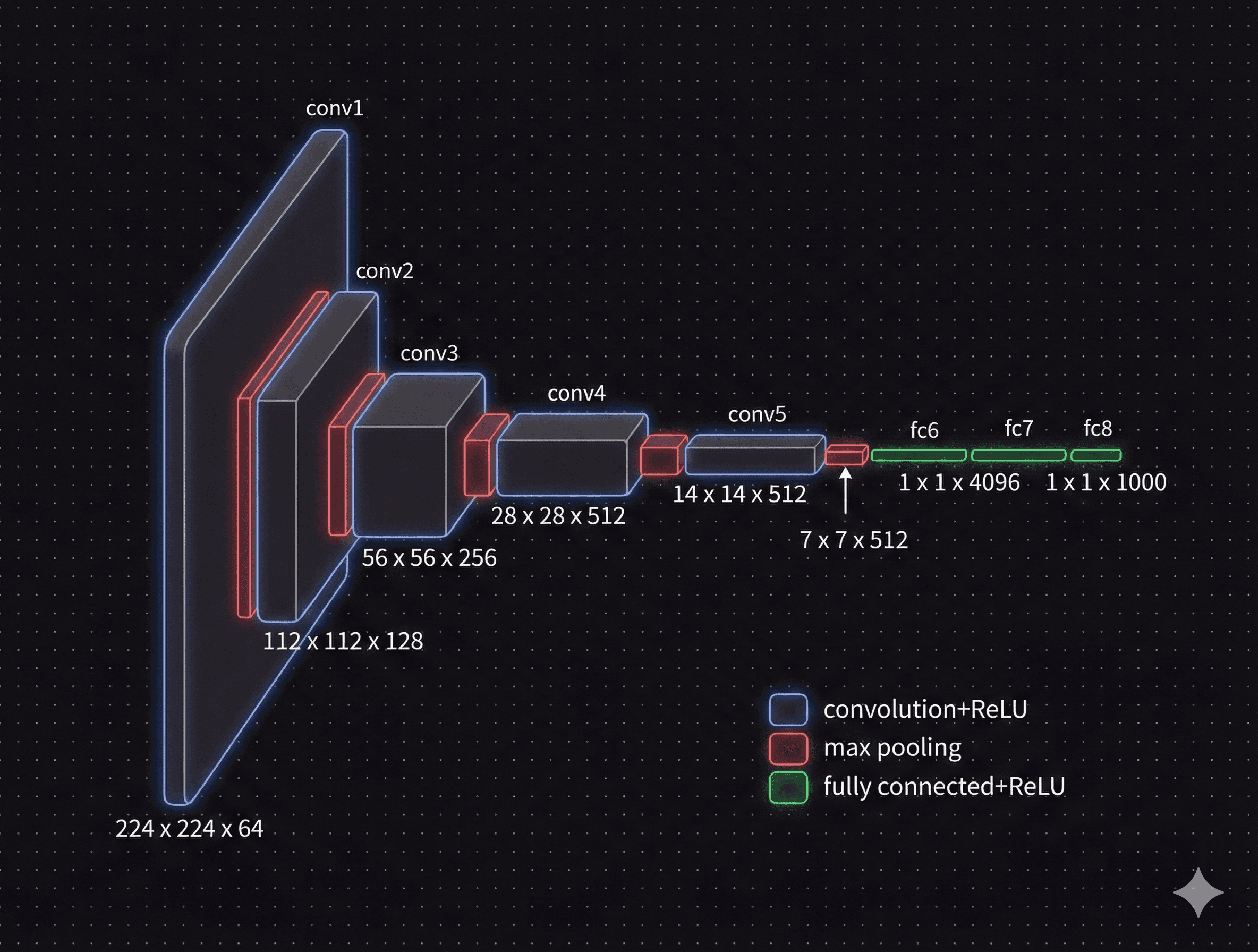
VGG-16 Feature Backbone used in Faster R-CNN
Diagram adapted from Ren et al., 2015
The feature extractor is a pretrained convolutional neural network (CNN) such as VGG-16 or ResNet-50. These networks are trained on large datasets like ImageNet and can extract details from the images including edges, textures, and object parts. Using a pretrained backbone allows the Faster R-CNN model to leverage the learned features from the CNN's pretrained information, improving detection performance, reliability while reducing training time.
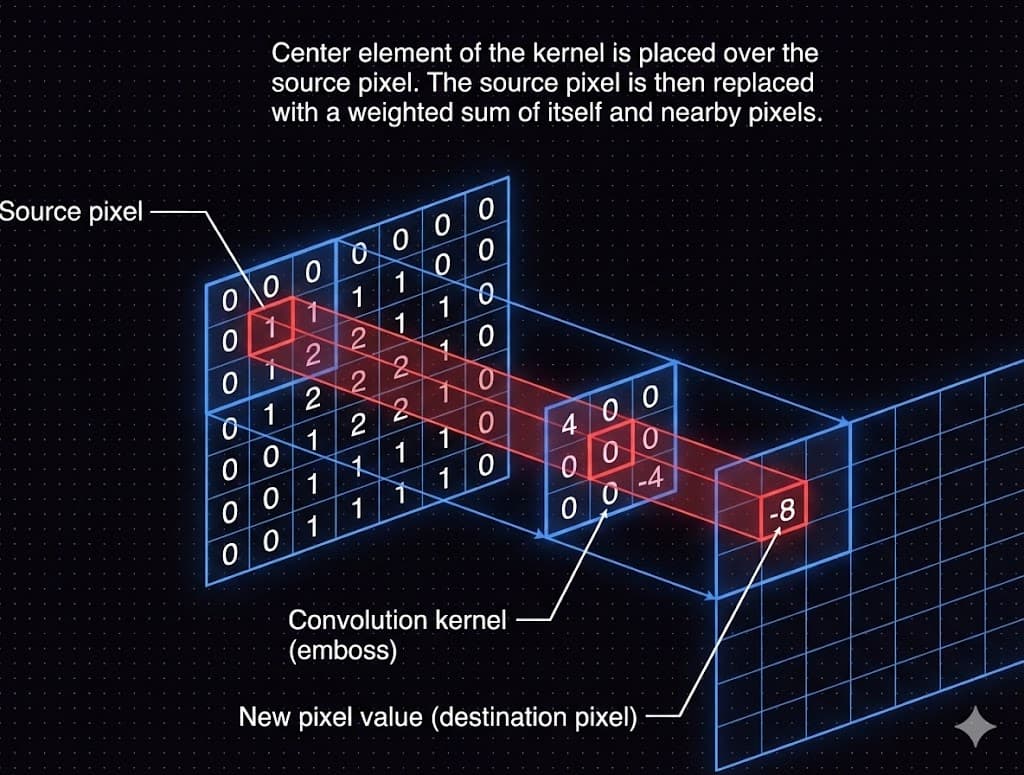
Intuition behind Convolution Operations in CNNs
The convolutional layers apply filters with weights leaned during a pretraining phase on a large dataset (ImageNet), and apply them to the images that are to be used for object detection so that the features inside the images can be extracted effectively. The deeper layers of the CNN capture higher-level features that are more relevant for object detection tasks. These feature maps are then passed to the RPN and RoI head for further processing.
src/app.ts
1class VGG_16_NFCL(tf.keras.Model):2 def __init__(self, name="backbone", **kwargs):3 super().__init__(name=name, **kwargs)4 5 # Layer 16 self.conv_1a = Conv2D(filters=64, kernel_size=3, padding='same', activation='relu', name="block1_conv1")7 self.conv_1b = Conv2D(filters=64, kernel_size=3, padding='same', activation='relu', name="block1_conv2")8 self.max_pool_1a = MaxPool2D(pool_size=2, strides=2, padding='same', name="block1_pool")9 10 # Layer 211 self.conv_2a = Conv2D(filters=128, kernel_size=3, padding='same', activation='relu', name="block2_conv1")12 self.conv_2b = Conv2D(filters=128, kernel_size=3, padding='same', activation='relu', name="block2_conv2")13 self.max_pool_2a = MaxPool2D(pool_size=2, strides=2, padding='same', name="block2_pool")14 15 # Layer 316 self.conv_3a = Conv2D(filters=256, kernel_size=3, padding='same', activation='relu', name="block3_conv1")17 self.conv_3b = Conv2D(filters=256, kernel_size=3, padding='same', activation='relu', name="block3_conv2")18 self.conv_3c = Conv2D(filters=256, kernel_size=3, padding='same', activation='relu', name="block3_conv3")19 self.max_pool_3a = MaxPool2D(pool_size=2, strides=2, padding='same', name="block3_pool")20 21 # Layer 422 self.conv_4a = Conv2D(filters=512, kernel_size=3, padding='same', activation='relu', name="block4_conv1")23 self.conv_4b = Conv2D(filters=512, kernel_size=3, padding='same', activation='relu', name="block4_conv2")24 self.conv_4c = Conv2D(filters=512, kernel_size=3, padding='same', activation='relu', name="block4_conv3")25 self.max_pool_4a = MaxPool2D(pool_size=2, strides=2, padding='same', name="block4_pool")26 27 # Layer 528 self.conv_5a = Conv2D(filters=512, kernel_size=3, padding='same', activation='relu', name="block5_conv1")29 self.conv_5b = Conv2D(filters=512, kernel_size=3, padding='same', activation='relu', name="block5_conv2")30 self.conv_5c = Conv2D(filters=512, kernel_size=3, padding='same', activation='relu', name="block5_conv3")31 32 def call(self, input_tensor, training=False, mask=None):33 x = self.conv_1a(input_tensor)34 x = self.conv_1b(x)35 x = self.max_pool_1a(x)36 37 x = self.conv_2a(x)38 x = self.conv_2b(x)39 x = self.max_pool_2a(x)40 41 x = self.conv_3a(x)42 x = self.conv_3b(x)43 x = self.conv_3c(x)44 x = self.max_pool_3a(x)45 46 x = self.conv_4a(x)47 x = self.conv_4b(x)48 x = self.conv_4c(x)49 x = self.max_pool_4a(x)50 51 x = self.conv_5a(x)52 x = self.conv_5b(x)53 x = self.conv_5c(x)54 55 return x56 57 def build_graph(self,input_size):58 x = tf.keras.layers.Input(shape=(input_size[0],input_size[1],3))59 return tf.keras.Model(inputs=[x],outputs=self.call(x))60 61 def build(self,input_shape):62 super().build(input_shape)63 self.load_weights('vgg16_weights_tf_dim_ordering_tf_kernels_notop.h5',by_name=True)The above code defines the VGG-16 backbone architecture using TensorFlow/Keras. It consists of multiple convolutional layers followed by max-pooling layers to progressively extract higher-level features from the input images.
The build method loads the pretrained weights from ImageNet to initialize the model. This is the VGG-16 model without the fully connected layers at the top, which are not needed for feature extraction in Faster R-CNN.
Information To Consider
When building TensorFlow models, always validate and sanitize your input data to prevent injection attacks. Use TensorFlow's built-in data pipelines to handle data loading and preprocessing securely.
Region Proposal Network (RPN)
The Region Proposal Network is a fully convolutional network that predicts object proposals directly from the feature maps produced by the backbone.
The RPN has multiple stages that work together:
- Anchor Generation: At each location on the feature map, a set of predefined anchor boxes of different scales and aspect ratios are generated.
- Objectness Score Prediction: For each anchor, the RPN predicts a score indicating the likelihood of the anchor containing an object.
- IoU Calculation: The RPN computes the Intersection over Union (IoU) between the predicted proposals and ground truth boxes to determine positive and negative samples for training.
- Proposal Classification: The RPN classifies each anchor as either foreground (object) or background (non-object).
- Bounding Box Regression: The RPN also predicts bounding box offsets to refine the anchor boxes to better fit the objects.
Region Proposal Network (RPN) Training Pipeline
Error Handling Strategy
A robust error handling system is critical for production APIs. We need to distinguish between operational errors (expected failures like validation errors) and programmer errors (bugs that should crash the process).
src/middleware/errorHandler.ts
1import { Request, Response, NextFunction } from 'express';2 3export class AppError extends Error {4public readonly statusCode: number;5public readonly isOperational: boolean;6 7constructor(message: string, statusCode: number, isOperational = true) {8 super(message);9 this.statusCode = statusCode;10 this.isOperational = isOperational;11 Error.captureStackTrace(this, this.constructor);12}13}14 15export function errorHandler(16err: Error,17req: Request,18res: Response,19next: NextFunction20) {21if (err instanceof AppError) {22 return res.status(err.statusCode).json({23 status: 'error',24 message: err.message,25 });26}27 28// Programmer error - log and return generic message29console.error('Unexpected error:', err);30return res.status(500).json({31 status: 'error',32 message: 'An unexpected error occurred',33});34}Performance Optimization
Premature optimization is the root of all evil. But when you know where the bottleneck is, optimize ruthlessly.
Once your API is functionally correct, the next step is ensuring it performs well under load. Here are the key strategies:
Connection Pooling
Database connections are expensive to create. Use a connection pool to reuse them across requests.
src/db/pool.ts
1import { Pool } from 'pg';2 3const pool = new Pool({4host: process.env.DB_HOST,5port: parseInt(process.env.DB_PORT || '5432'),6database: process.env.DB_NAME,7user: process.env.DB_USER,8password: process.env.DB_PASSWORD,9max: 20, // Maximum connections in pool10idleTimeoutMillis: 30000,11connectionTimeoutMillis: 2000,12});13 14export default pool;Response Caching
For endpoints that don't change frequently, implement caching at multiple levels:
src/middleware/cache.ts
1import { Request, Response, NextFunction } from 'express';2 3const cache = new Map<string, { data: unknown; expiry: number }>();4 5export function cacheMiddleware(ttlSeconds: number) {6return (req: Request, res: Response, next: NextFunction) => {7 const key = req.originalUrl;8 const cached = cache.get(key);9 10 if (cached && cached.expiry > Date.now()) {11 return res.json(cached.data);12 }13 14 // Override res.json to cache the response15 const originalJson = res.json.bind(res);16 res.json = (body: unknown) => {17 cache.set(key, {18 data: body,19 expiry: Date.now() + ttlSeconds * 1000,20 });21 return originalJson(body);22 };23 24 next();25};26}Production Caching
In production, replace the in-memory Map with Redis for caching that persists across restarts and is shared between multiple server instances. This is essential for horizontally scaled deployments.
Conclusion
Building scalable APIs is as much about architecture decisions as it is about code. By following these patterns — layered architecture, proper error handling, connection pooling, and strategic caching — you create systems that can grow with your user base.
Key Takeaways
Start with clean separation of concerns, add security middleware from day one, implement structured error handling, and optimize only after measuring. These fundamentals will serve you from your first user to your millionth.